
Is epoxy paint good for garage floors?
DIY not recommended for long term. Most garage floor paints are one-part. In the product technical data sheet for Rust-Oleum’s 1-Part Epoxy Floor Paint the resin is shown as modified acrylic – not epoxy. This paint offers a quick solution, but after a harsh winter with salt and slush, and hot tires in July, peeling may occur where vehicles are parked. For a long lasting garage floor you’ll want a 2-part epoxy applied to a diamond-ground slab with a salt resistant top layer.
What can and can’t be achieved with a DIY option and a professional solution for your garage floor in Mount Vernon or Westchester?
2-part epoxy
A 2-part epoxy is made of a resin and a hardener. Once combined, the chemical reaction creates a hard, thick layer. With 1-part paints, however, there is no chemical reaction, and therefore the film formed is much thinner.
On the data sheet for Rust-Oleum’s Concrete and Garage 1-Part Epoxy Floor Paint, it is clear the resin is modified acrylic polymer. The data sheet states ‘vehicle traffic allowed after 5 days’.
Paint can be suitable for some. For a garage used as storage (without hot or wet vehicles), this paint can give a nice upgrade to gray concrete and last a few seasons. If you park an everyday car in the garage, it may not be suitable.
Winters can be tough. Most salt applied on New York roads is rock salt mined within the state, and Westchester garages get it from vehicle tires from December to March. The slush melts and leaves salt water pooling on the floor, which causes freeze-thaw of the floor around the entrance.
Regulations
In New York, floor coatings made since January 1st 2021 must not exceed 100 g/L VOC. We make use of floor coatings which meet these standards.
How to prepare garage floor for coating?
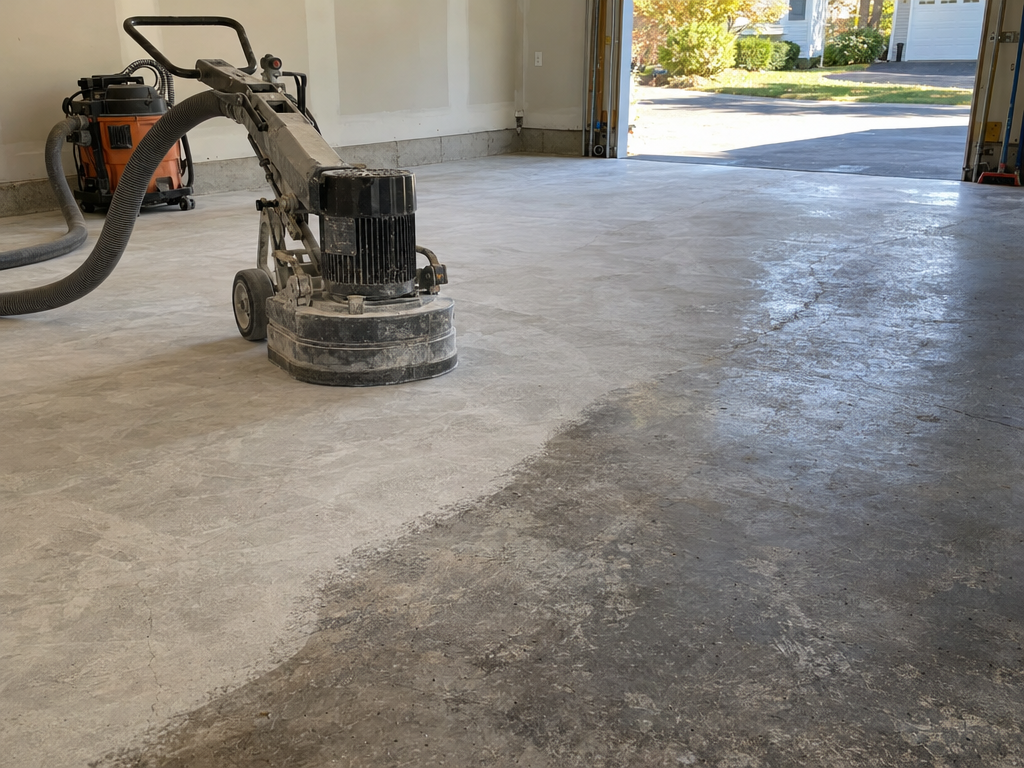
To ensure a coating will last well, the existing surface should be removed. We diamond grind the entire floor to create a key for the new coating. Acid etching is no longer recommended by Sherwin-Williams, who produce resins for contractors, as it produces an inconsistent result and doesn’t remove curing agents or oils.
Fixes
Cracks, chipped areas around the entrance, and salt damage should be cleared out and filled so they don’t show in the finished floor.
Moisture testing
If there is moisture rising in the concrete beneath the garage, blistering and delamination will occur, regardless of how high quality a coating is applied. If a high moisture level is found, we will either apply a moisture resistant primer or allow the floor to dry.
Once all of the above is complete, we can begin applying the coating: an epoxy primer, optional flakes, and a salt and sun resistant top coat.
Things to do before we arrive
- Make sure the garage is empty (including wall mounted shelves).
- Remove grit and salt from the floor.
- Point out oil stains and pooling water.
- Let us know if the floor has been painted, sealed or coated before.
- Consider color choices for flakes or a solid finish.
What our crew does
- Diamond grind the entire floor.
- Cut and fill cracks and salt damage.
- Conduct a moisture test.
- Strip an existing peeling kit coating.
- Apply the primer, optional flakes and top coat.
Call us at (914) 863-7887 to let us know the size of your garage, and send us a few pictures of your floor. We can then let you know what work needs to be completed.